
This year marks the 120th birth anniversary of Goan artist, Angelo da Fonseca (1902-1967). To commemorate the occasion, Savia Viegas has curated an exhibition titled Angelo da Fonseca’s Indian Madonna, which can be viewed at Goa’s Xavier Center of Historical Research (XCHR) between December 2022 and March 2023 (the exhibition is open from Monday to Friday between the hours of 10AM to 1PM).
In this interview, Viegas speaks to the themes of her exhibition, reflecting upon how Angelo da Fonseca created a South Asian Catholic aesthetic in his numerous depictions of the Madonna. His work, as Viegas notes, also bears the imprint of the social, political, and cultural influences of his contemporary moment, a time when Goa and India were going through much change at the end of European colonialism.
Savia Viegas is an academic, fiction writer, and artist who resides in Carmona, Goa. She has exhibited her work in India and Portugal. In 2003-2004, she was a Senior Fulbright Fellow. Her novels, Tales from the Attic (2007) and Let me tell you about Quinta (2011) have been taught in postcolonial studies courses at the University of Lisbon (MA in Translation) and William & Mary in Virginia, USA. Her research on artist Angelo da Fonseca was supported by a grant from India Foundation for the Arts in 2010-11. Subsequently, a Fundação Oriente travel grant to Portugal supported further research in 2017. The life and work of Angelo da Fonseca is the subject of her forthcoming book, which will be published in 2023.
RBF: This is the first time in several years that the works of Angelo da Fonseca have been exhibited publicly in his homeland after you had last curated shows of his art at the same venue (XCHR) between 2011 and 2015. Apart from the fact that this year marks the artist’s 120th birth anniversary, what led to this new exhibition on the theme of the Indian Madonna and the idea to pair the opening with a children’s art competition?
SV: My journey into understanding the oeuvre of Angelo da Fonseca pitted me into several cul-de-sacs. But finally last year, the pieces began to fit together coherently, allowing me to understand his art and also how to stitch it into the larger quilt of nation, religion, and the world. Goa’s conservatism has had an inbuilt antipathy towards anyone who breaks the doxa of the habitus. Such individuals are branded as “fanfaraos” (braggarts) and often banished into exile.
.jpg)
from Calcutta, he relocated to Poona, pursued by an uproar of conservatism and fear that he would not be able to paint his choice of subjects in Goa. Most of his paintings are of the Madonna and of women.
For me, the borrowing, the variety and the specificity of this theme was really kaleidoscoping itself into an exhibition even before we began to move the frames.
His contribution to the Madonna iconography was most intense and ruled by many factors. Ivy Muriel da Fonseca (1928-2015), wife of the artist, said that Angelo was the last of seventeen children and lost his mother within a few years of his birth. Having been raised by his older sisters he had a special love for painting the mother figure. “I have painted the Virgin Mary in all her aspects,” he wrote, “from being the daughter of Santana to being the mother in Nativity and the Pieta as well as the Mediatrix of all Graces.”
I felt that the only way young people could absorb and absorb Angelo da Fonseca, was to engage them with ideas the artist worked with and so an art competition was decided on. It would help create a generation of children that were familiar with the work of Angelo da Fonseca. I must say the idea caught on very well among them.
RBF: At the exhibition, I was struck by a piece I had not seen before: Presentation of Mary in the Temple (1954) In it, a young Mary, draped in a ghagra choli (to show her unmarried status) and with a halo around her head, is seen on the steps of a temple, being gently thrust forward by her beatific looking mother, who is sari-clad. Speaking very much to the exhibition’s theme of the Indian Madonna, the painting brings together a confluence of religious and regional representations. How might we think of this and other works by Angelo da Fonseca as his contemplation of Goa, which was then still ruled by the Portuguese, as being on the edge of (and perhaps soon to be annexed by) newly independent India?
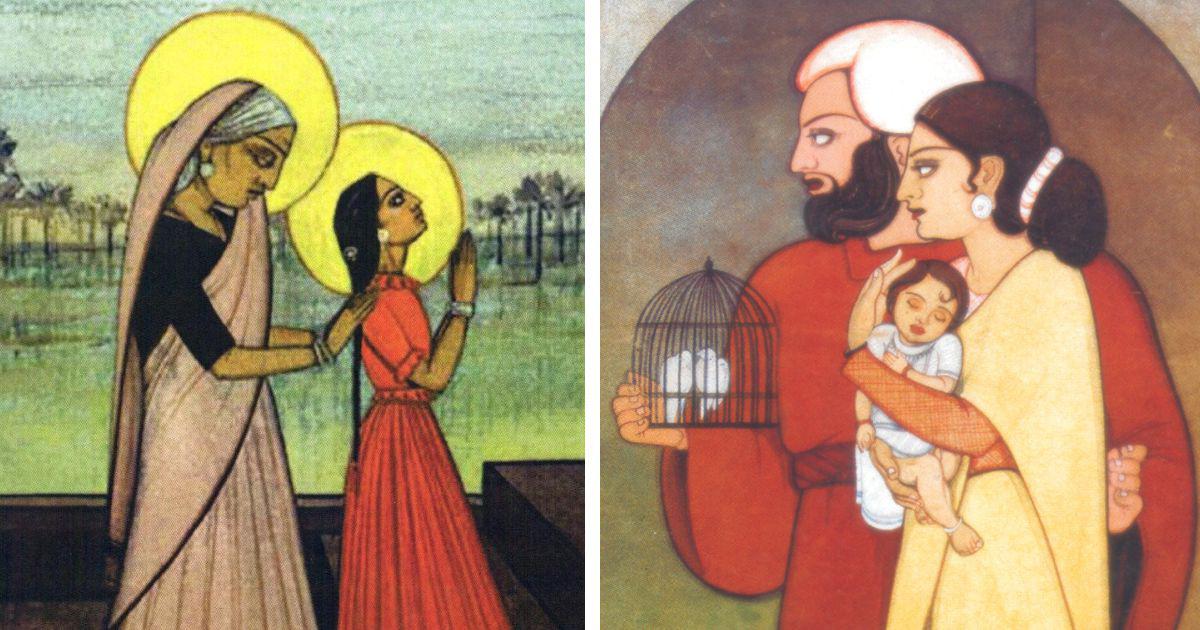
SV: Angelo da Fonseca lived in various regions of colonial India for his schooling, right from the early years, exposing him to its cultural diversity and the rising ferment against colonialism. He painted the joyful, sorrowful and glorious mysteries of Christianity, setting them in an Indian cultural landscape. Christian saints he depicted with Asiatic skin tones, but also clearly visible in many of these works was the political subtexts of events driving the polity and State in the contemporary moment of his work.
In Presentation of Mary in the Temple, an elderly Santana is leading Mary into the precincts of a temple. One sees the rope attached to the bell which announces the presence of the worshipper to the sacred place. The subtext clearly signifies Mother India leading Goa back into the fold of Indian culture. It is an uncanny parallel. The painting had been created in connection with the International Marian Year (1954) as his work was in great demand abroad. The dateline also coincides with the time of the tabling of the Indian Constitution in 1950 and the formation of states on a linguistic basis, as well as Goa’s own complex colonial status.
Goa stood excluded from this great reunion and yet uncovered by the Constitution. It was only after 1961 and the liberation of Goa that the tiny enclave was able to be part of the Indian Union of States and Territories. Several cultural artistes had played around with this idea, albeit in differing ways.

play, titled Goa, deals with the Indian takeover of its namesake. The preface to the play references an encounter between the playwright and his friend Mario, the local Portuguese administrator who is proud of Goa and who praises a Goan village “nestling amidst green hills and valleys.” Then, the play opens on an evening setting where village “regulars” meet at the outdoor “patio” benches. Senhora Miranda, a fair-skinned woman of about forty, enters the scene, splendidly dressed in the latest Portuguese fashion with a colourful parasol in hand. She is accompanied by her nubile daughter who is both blind and deaf. The daughter is described as being “dark looking and about fourteen with a beautiful innocent face and a strange voice.” Intertwined in the personas of the mother-daughter duo are Goa of the colonial past and the liberated present.
RBF: Who is Angelo da Fonseca’s Indian Madonna? Is she a consistently represented icon throughout the works on display in this exhibition?
SV: No. A stylistic India-trotting best describes Angelo da Fonseca’s approach. His Madonna is an elite maiden in Annunciation (1954), but she is also an Andhraite working class girl in another work from the mid-1950s. These images, reflecting both the elite and the poor, in a sense address, both, rich and poor viewers.
His icons he posits onto the fertile cultural landscapes of Goa, Tamil Nadu, and Maharashtra, absorbing their cultural specificity and infusing it into his figures to create a new indigenous narrative for Christian worshippers in India. The Hindu, the Muslim, and the Catholic he absorbs in equal measure for, to him, they represent the diversity of India.
RBF: Stepping away from the specificity of this exhibition for a moment, could you comment on the artist’s place in the realm of modern art both in India and internationally?
SV: As a researcher I am loathe to take any positions that do not fit into my immediate research paradigm. I am just a researcher on the work of the artist. It is now for others to extend the frontiers of the debate. Angelo da Fonseca shied away from the term “modernist” and called himself “an iconographer” or “a practitioner of the Bengal school,” which was a revivalist school. Also, many of India’s art historians date modernism to the post-1960s.
Modernism is an art movement that critics and historians have identified, beginning with the realism of Gustave Courbet (1819-1877) and culminating in individualist and abstract art. It essentially has reference to the fragmentation of the human form in art with the rise of the new schools of dadaism and surrealism. The development of flight in 1903 and the invention of the atom bomb had also changed perspectives and ways of narration in art. The Vatican think tank did not want Christian images to be fragmented. After two World Wars, Europe had been totally devastated.
Newspaper reports covering Angelo da Fonseca’s exhibitions in 1948-50 in England and Ireland reveal that Catholics expressed hope that Asia which would keep alive the sublime art of Christianity through its images. However, as Paulo Varela Gomes points out, in Portugal, his art was poorly received as Angelo da Fonseca had declared himself an “Indian artist” although he was actually born and raised as a Portuguese subject.

After he meets Fr. Heras, Angelo da Fonseca’s images undergo a transition and begin to look more and more like icons – images that are ethereal and not weightbearing and by the light of their features reveal that they mediate between the Earth and the heavens.
RBF: There is something to be said about the intersection of the theme of this exhibition, centered as it is on the iconicity of Mary, and the women in da Fonseca’s life, many of whom come to be represented in his oeuvre. What role did his late wife, Ivy Muriel da Fonseca, play in his legacy?
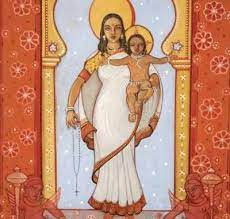
SV: Having known Angelo da Fonseca’s extended family in my childhood put me in a privileged position to make these connections of intersecting bonds between the iconicity of Mary, the women in his life, as well as the flow of events that finally resulted in the birth of the sovereign democratic republic of India. In Angelo da Fonseca’s oeuvre, the iconography of the Madonna varies from her as the daughter of Santana, as a young woman in Annunciation (1954), in Visitation (1954), in Flight into Egypt (1942), and as a mother in representations of the Nativity and the Epiphany.
Like Fra Angelico who inspired him, Angelo da Fonseca declared that he prayed before starting a painting. The artist often declared that he did not allow secular paintings or models to disturb his concentration of the holies. At another point he declared that it was not important who inspired the painting if the end result was to serve the purpose it was painted for.
Right from his first watercolour of Guita Roy to numerous sketches of family members – nieces, cousins and friends, or working women from the street cultures of Poona – he worked incessantly, sketching and absorbing ideas. But he did also paint from memory for features of his family members in their young avatars, which appear in his works of the 1950s when these figures are already old. He paints an Irish woman Eillish Killean during his sojourn abroad. Later, she appears as Mary Magdalene in his sorrowful mysteries series.
.jpg)
have to keep in mind here that his journey to create a Madonna begins in the 1930s and he keeps adding and chipping away at the early configurations that he creates with the single-minded purpose akin to a sculptor with a piece of marble.
His superb coloration and Botticelli lines would have augured him success even in secular salons, but he continues to paint Christian narratives and exhibit in humble quasi-religious settings. “Are these images for worship?” disgruntled friends ask. “How can we worship your wife as Mother Mary?’ To this he had a stock reply. “Do you think artists before me really painted the divine Mother?”
RBF: To date, there is no state-sponsored repository of Goan art available where the public can view the work of Goan artists in their own home state. How has this impacted the reception and legacy of Goan artists and how might efforts like this present exhibition remedy such a situation if at all?
SV: Yes, I agree about the lack of such spaces in Goa.
When I was researching on Goa’s artists and writers
for a poster I was
commissioned to do for the Goa Arts and Literature Festival in 2018, it was shocking
to discover that several noted Goa-born artists spent most of their active
professional lives in exile in other lands. Take the example of a few, such as Francis Newton Souza,
Angelo da Fonseca, Angela
Trindade – the list, however, is longer!
On the other hand, Vamona Navelcar returned to India and to his natal abode in Pomburpa in Goa after several years abroad. He lived to regret his decision for he spent the remainder of his life as a prolific artist but somehow lived exiled in his red Matisse-ish home by the river.
From Scroll.


