Thursday, December 26, 2019

"2046, The Past" in THE PEACOCK: The Prof (23 November 2019)


The year is 2046. Outside, there is a place where nothing changes. An intergalactic train can take you there, but only one person has ever returned. Inside are the ghosts of the past. In between exist memory, melancholia, and myth. 

This is Hong Kong, neither past perfect nor the future progressive, as speculatively rendered in the film 2046 (2004) by Wong Kar-wai. Considered an oblique follow up to his earlier In the Mood for Love (2000), which was set in the 1960s, the disjointed stories of the director’s later film circulate betwixt everlasting nostalgia and the impending unknown. 

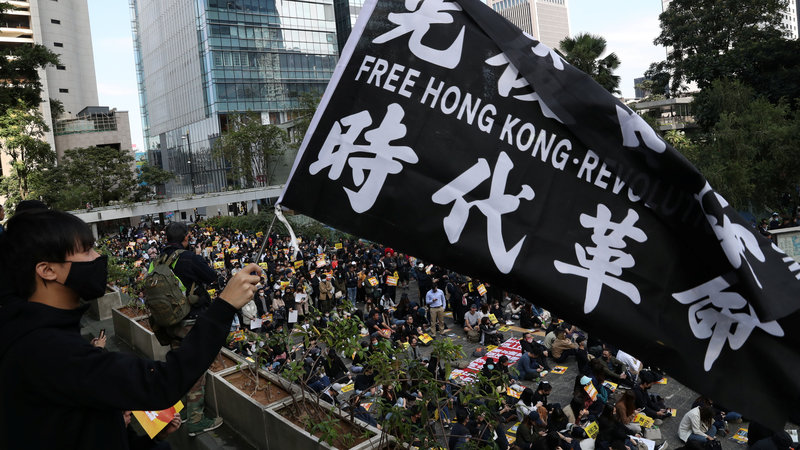
The year of the film’s title signals when Hong Kong’s special administrative status ceases. A colony of Britain until its 99-year lease of the region ended in 1997, Hong Kong’s reversion to Chinese rule was buffered by an allowance for it to function in semi-autonomy for another 50 years. However, what the last few months have made evident to the world is that Hong Kong’s youth seek sovereignty. 


Long before this year’s pro-democracy protests and the Umbrella Revolution of 2014, films from Hong Kong have grappled with questions of cultural and political uncertainty. May Fung’s meditation on these matters takes on a mystical quality in the short film She Said Why Me (1989). Most recently screened publicly as part of the exhibition Five Artists: Sites Encountered (2019) at Kowloon’s M+ Museum, the digital print fossilizes the grainy quality of the original VHS recording, rendering it even more esoteric. In it, a woman walks from an ancient temple located in Hong Kong’s countryside to the towering architecture of the busy city. As she makes her away across the enclave’s landscape, beginning at a site that is emblematic of tradition and the past and finishing in the present of urban modernity, her steps are hesitant despite being upon the familiar terrain of her homeland. She is blindfolded. Arms outstretched, her sightless perambulation hints at Hong Kong’s indeterminate future. 

Made in the years before Hong Kong’s handover, Fung’s work captures the anxieties of a land on the precipice of change. At IFFI 2019, other films similarly portray contemporary angst across the globe. All produced this year, several of these features make their Asia or India debut here in Goa. The festival’s opening film, Italy’s Despite the Fog, springs from the crisis that has brought political refugees to Europe’s shores. Hearts and Bones is also about refugees, but in Australia. Climate change is the subject of the eleven short movies that comprise the multi-country Interdependence, while an environmental apocalypse wreaks havoc in The Halt/Ang Hupa from the Philippines.  

Occurring in 2034, The Halt’s cataclysmic view telescopes current fears into yonder years, mirroring the unstable narrative of the futuristic dreamscape that is 2046. These forward-looking films urge us to look back from the future. As today’s Hong Kong struggles to establish its political will, the cinematic legacy leading up to this moment envisions multiple possibilities, even if tentatively. This, not in didactic storytelling, but in the very form of the films that emerged in this period of ambiguity.  
Writing about 2046, Roger Ebert remarked on how the film was late to arrive at Cannes 2003: “[T]he final reel reportedly arrived at the airport almost as the first was being shown. It was said to be unfinished … [T]here were skeletal special effects that now appear in final form, but perhaps it was never really finished in [Kar-wai’s] mind.”

The future, then, as this may suggest is uncertain precisely because its past is always present, forever a time to foresee differently.

From The Peacock.

Monday, December 16, 2019

"Roller Reel" in THE PEACOCK: The Prof (21 November 2019)


Martin Scorsese rubbed fans of the Marvel franchise the wrong way when he said of the superhero films that he saw them less as cinema and more like “theme parks.” Speaking in an October 2019 interview, the famed director explained that he didn’t feel Marvel films were the usual stuff of human experience traditionally seen on screen. But Marty seems to have forgotten that one of his own films has been incorporated into an amusement park. 

Cinecittá World, opened in 2014, is built on the site of Dino De Laurentiis’ former studio, Dinocitta. Situated just outside Rome, the theme park is a tribute to the involvement of Italians in cinema. An Italian American, Scorsese’s nineteenth century-set Gangs of New York (2002) provided the inspiration for the look of Cinecittá. Both the film and the park hark back to Hollywood’s Spaghetti Western era of the mid-1960s, so called for the involvement of Italians, such as Sergio Leone, in the making of the sub-genre. Ennio Morricone who composed the soundtrack for films of that time also did the music one hears at Cinecittá.

Yet, isn’t it intriguing that it is the Western, a film genre so emblematic of America, that informs Cinecittá’s attempts to pay homage to Italian cinematic heritage? 

Sure, the genre of the Western suitably provides the backdrop of adventurism that amusement park-goers crave, replete as it is with fantasies of taming the wild and encountering savages (never mind that these are natives defending their homeland against marauders). But there’s more to be gleaned of how the Western sets the stage for a roller coaster ride of conflation between national sentiment and the movies at theme parks.


Let’s depart Italy’s Cinecittá and enter Bollywood Parks Dubai (BPD). Established in 2016, BPD is the only theme park in the world to pay tribute to India’s film industry. But just like Cinecittá relocates the American Western to Europe, BPD brings Bollywood to the Emirates. And if America had its Spaghetti Westerns, then 1970s’ India cooked up the Curry Western – films that use the ethos and look of the Wild West as the setting for desi drama. 

The most famous of these was the Amitabh Bachchan-starrer Sholay (1975). One of the rides at BPD recreates the film’s tale of two petty crooks conscripted by a retired policeman to protect his village against dacoits. As part of the ride, guests shoot at bandits on a screen which mirrors the look of the film’s frontier aesthetic that could be mistaken for a scene from a Spaghetti Western. Considering, though, that the lawless west of Sholay is actually the east, how does one tell the Indians from the cowboys? 

What’s more, on my visit to BPD, nearly every one of the park-visitors involved in the pretend shootout on the ride was Arab or South Asian, the latter making up the largest demographic in Dubai. As much as amusement parks may seem separated from the “real world,” I had to wonder if the simulated violence I was witnessing might somehow reflect a bit of the tensions of the outside world, especially with South Asians outnumbering Arabs in the Emirates. Further, the curious spectacle of South Asians shooting people who looked like themselves on the video game-like ride itself made me muse if there was a caste/class angle to ponder. 

Inadvertently, the Curry Western, as it is employed at BPD serves as a metaphor for the westward frontier crossing of South Asians into the Middle East, possibly along with multicultural frictions. At Cinecittá, the Spaghetti Western is reminiscent of the immersion of Italians into American culture, presaged indirectly by the journey of Columbus. That original Italian thrill-seeker, who erroneously “discovered” the region, much to the detriment of indigenous peoples, had gotten lost on his way to the Wild East. Even as history and the tensions of the outside world are never fully excluded, theme parks immerse participants into cinematic realms, the vicariousness of film-watching translated into a physical experience of fantasy.

As for the Marvel movies being “theme parks,” Scorsese may not be far off the mark. Aren’t superheroes after all just cowboys in capes?

From The Peacock.

Monday, December 9, 2019

"Movies on the Blackboard" in THE PEACOCK: The Prof (20 November 2019)


Movie days in my classroom are an event. Rather than have my students watch required films in the privacy of their dorm rooms, I organize screenings for my students at my college’s mini theatre and we even have popcorn. As enjoyable as these “non-classroom” occasions are, they aren’t any less academic. Instead, students use the opportunity to critically analyse the films as artefacts of a time and place, part of the zeitgeist of a cultural moment. Employing film in my teaching and academic research, I attempt to understand how cinema is more than an art form that runs parallel to our life experience. Just as my students do when they watch pictures in class, my columns over the next few days will think about how the movies are exemplary of our existence, even constitutive of it, but not always in obvious ways.    

Take my Interpreting Literature class – the gateway course to the English major at William and Mary, where I teach. In it, I pair texts from the canon (think Shakespeare, Chaucer, or Dickens) with work, generally, by more contemporary writers (think women, probably not white, and usually not dead). Between the study of corresponding books, linked by subject matter but separated by time, I’ll include a film that can help bridge the material but also illustrate concepts, portray a place, or bring nuance to words. Yet, how a syllabus puts disparate texts in conversation with one another may not be self-apparent. For instance, what does the Vietnam War have to do with the Belgian Congo or Nigeria on the eve of European colonization? A lot, as it turns out, thanks to Francis Ford Coppola’s Apocalypse Now (1979).

After they’d read Heart of Darkness (1899) and before they encountered Things Fall Apart (1958), Chinua Achebe’s response to Joseph Conrad, my students watched Coppola’s opus, which is inspired by Conrad’s turn-of-the-century novella. Apocalypse Now’s river-ride between war-torn 1970s’ Vietnam and Cambodia may seem far off from the late-nineteenth century water-bound journey Marlow takes in the depths of the Congo in search of Kurtz. But my students quickly picked up on the themes the two share: imperialism as failure and the belief in racial superiority as folly. Despite this, neither Conrad nor Coppola adequately develop their non-white characters, women especially. When students meet Okonkwo, the proud but fatally flawed Igbo protagonist in Things Fall Apart, as well as the rest of the people who constitute his life, they are given a sense of how “the other” was affected by colonialism, even resisting it.  

When they met in 1980, Black American writer James Baldwin confided in Achebe: “That man, Okonkwo, is my father. How he got over, I don’t know, but he did.” By this, Baldwin didn’t mean that the African origins his father shared with Okonkwo, separated by a legacy of slavery, were what prompted him to see the fictional character as his parent. Baldwin’s statement had more to do with Okonkwo’s patriarchal nature – his brooding, sometimes overbearing demeanour – and how there was a kind of universality to this character that transcended time, place, and even the confines of a book. 


Interestingly, upon watching Apocalypse Now, several of my students – all millennials who had never seen (or, in many cases, even heard of) the film – talked to their parents about what their lives were like during the America of the Vietnam War period. My students reported that their parents were surprised by the question and even more so that it arose from watching Coppola’s war epic in the classroom. “Did you know that the film is based on Heart of Darkness?” a student said her father asked, to which she responded with an eyeroll. But wanting to push my students further, I urged them to consider how the American film might play to a Southeast Asian audience. Would Vietnamese viewers see themselves in Coppola’s Vietnam like Baldwin saw his father in Achebe’s Nigeria? 

These are the kinds of questions that the study of film allows us to grapple with. Sometimes enjoyable, other times thought-provoking, the movies are our cultural moment, mirror of our past and, perhaps, even what we don’t always see. 

From The Peacock.