Showing posts with label Goan Aesthetics. Show all posts

Tuesday, December 20, 2022

"The South Asian Catholic Aesthetic of Artist Angelo da Fonseca's Indian Madonnas" in SCROLL (18 December 2022)

This year marks the 120th birth anniversary of Goan artist, Angelo da Fonseca (1902-1967). To commemorate the occasion, Savia Viegas has curated an exhibition titled Angelo da Fonseca’s Indian Madonna, which can be viewed at Goa’s Xavier Center of Historical Research (XCHR) between December 2022 and March 2023 (the exhibition is open from Monday to Friday between the hours of 10AM to 1PM).

In this interview, Viegas speaks to the themes of her exhibition, reflecting upon how Angelo da Fonseca created a South Asian Catholic aesthetic in his numerous depictions of the Madonna. His work, as Viegas notes, also bears the imprint of the social, political, and cultural influences of his contemporary moment, a time when Goa and India were going through much change at the end of European colonialism.

Savia Viegas is an academic, fiction writer, and artist who resides in Carmona, Goa. She has exhibited her work in India and Portugal. In 2003-2004, she was a Senior Fulbright Fellow. Her novels, Tales from the Attic (2007) and Let me tell you about Quinta (2011) have been taught in postcolonial studies courses at the University of Lisbon (MA in Translation) and William & Mary in Virginia, USA. Her research on artist Angelo da Fonseca was supported by a grant from India Foundation for the Arts in 2010-11. Subsequently, a Fundação Oriente travel grant to Portugal supported further research in 2017. The life and work of Angelo da Fonseca is the subject of her forthcoming book, which will be published in 2023.

RBF: This is the first time in several years that the works of Angelo da Fonseca have been exhibited publicly in his homeland after you had last curated shows of his art at the same venue (XCHR) between 2011 and 2015. Apart from the fact that this year marks the artist’s 120th birth anniversary, what led to this new exhibition on the theme of the Indian Madonna and the idea to pair the opening with a children’s art competition?

SV:  My journey into understanding the oeuvre of Angelo da Fonseca pitted me into several cul-de-sacs. But finally last year, the pieces began to fit together coherently, allowing me to understand his art and also how to stitch it into the larger quilt of nation, religion, and the world. Goa’s conservatism has had an inbuilt antipathy towards anyone who breaks the doxa of the habitus. Such individuals are branded as “fanfaraos” (braggarts) and often banished into exile.

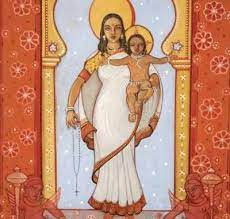
Angelo da Fonseca had a penchant for the Madonna iconography. Depicting her in a sari after his return
from Calcutta, he relocated to Poona, pursued by an uproar of conservatism and fear that he would not be able to paint his choice of subjects in Goa. Most of his paintings are of the Madonna and of women.

For me, the borrowing, the variety and the specificity of this theme was really kaleidoscoping itself into an exhibition even before we began to move the frames.

His contribution to the Madonna iconography was most intense and ruled by many factors. Ivy Muriel da Fonseca (1928-2015), wife of the artist, said that Angelo was the last of seventeen children and lost his mother within a few years of his birth. Having been raised by his older sisters he had a special love for painting the mother figure. “I have painted the Virgin Mary in all her aspects,” he wrote, “from being the daughter of Santana to being the mother in Nativity and the Pieta as well as the Mediatrix of all Graces.”

I felt that the only way young people could absorb and absorb Angelo da Fonseca, was to engage them with ideas the artist worked with and so an art competition was decided on. It would help create a generation of children that were familiar with the work of Angelo da Fonseca. I must say the idea caught on very well among them.

RBF: At the exhibition, I was struck by a piece I had not seen before: Presentation of Mary in the Temple (1954) In it, a young Mary, draped in a ghagra choli (to show her unmarried status) and with a halo around her head, is seen on the steps of a temple, being gently thrust forward by her beatific looking mother, who is sari-clad. Speaking very much to the exhibition’s theme of the Indian Madonna, the painting brings together a confluence of religious and regional representations. How might we think of this and other works by Angelo da Fonseca as his contemplation of Goa, which was then still ruled by the Portuguese, as being on the edge of (and perhaps soon to be annexed by) newly independent India?
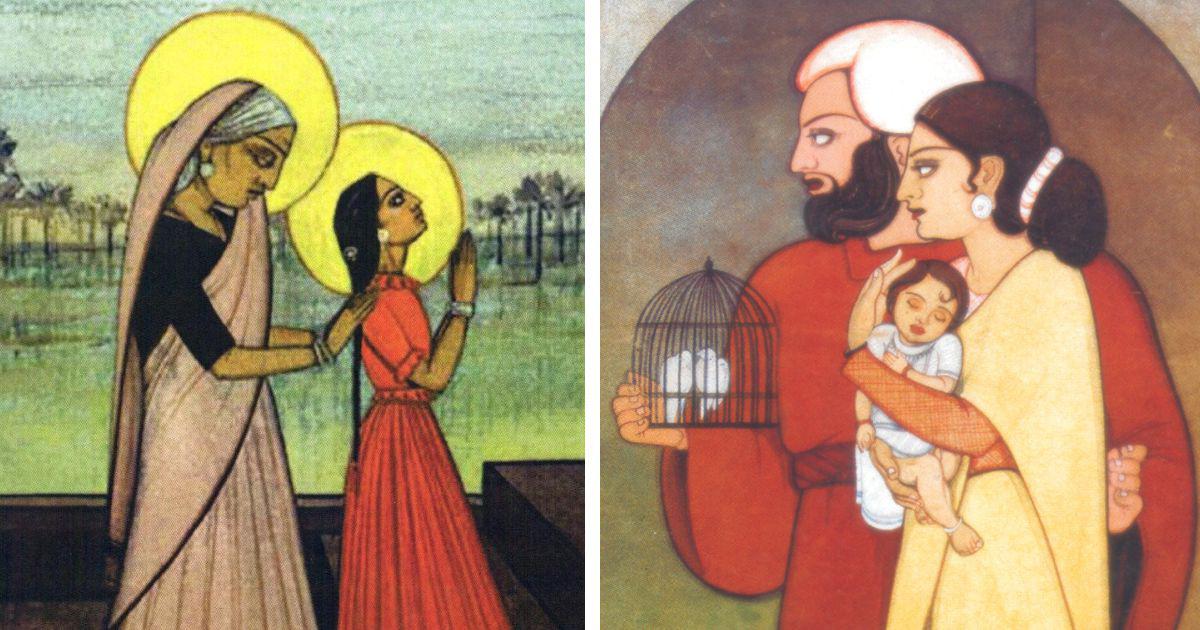

SV:  Angelo da Fonseca lived in various regions of colonial India for his schooling, right from the early years, exposing him to its cultural diversity and the rising ferment against colonialism.  He painted the joyful, sorrowful and glorious mysteries of Christianity, setting them in an Indian cultural landscape. Christian saints he depicted with Asiatic skin tones, but also clearly visible in many of these works was the political subtexts of events driving the polity and State in the contemporary moment of his work.

In Presentation of Mary in the Temple, an elderly Santana is leading Mary into the precincts of a temple. One sees the rope attached to the bell which announces the presence of the worshipper to the sacred place. The subtext clearly signifies Mother India leading Goa back into the fold of Indian culture. It is an uncanny parallel. The painting had been created in connection with the International Marian Year (1954) as his work was in great demand abroad. The dateline also coincides with the time of the tabling of the Indian Constitution in 1950 and the formation of states on a linguistic basis, as well as Goa’s own complex colonial status. 

Goa stood excluded from this great reunion and yet uncovered by the Constitution. It was only after 1961 and the liberation of Goa that the tiny enclave was able to be part of the Indian Union of States and Territories. Several cultural artistes had played around with this idea, albeit in differing ways.

For example, in 1964, Asif Currimbhoy wrote a play which was never performed in India at the time. The
play, titled Goa, deals with the Indian takeover of its namesake. The preface to the play references an encounter between the playwright and his friend Mario, the local Portuguese administrator who is proud of Goa and who praises a Goan village “nestling amidst green hills and valleys.” Then, the play opens on an evening setting where village “regulars” meet at the outdoor “patio” benches. Senhora Miranda, a fair-skinned woman of about forty, enters the scene, splendidly dressed in the latest Portuguese fashion with a colourful parasol in hand. She is accompanied by her nubile daughter who is both blind and deaf. The daughter is described as being “dark looking and about fourteen with a beautiful innocent face and a strange voice.” Intertwined in the personas of the mother-daughter duo are Goa of the colonial past and the liberated present.

RBF: Who is Angelo da Fonseca’s Indian Madonna? Is she a consistently represented icon throughout the works on display in this exhibition?

SV: No. A stylistic India-trotting best describes Angelo da Fonseca’s approach. His Madonna is an elite maiden in Annunciation (1954), but she is also an Andhraite working class girl in another work from the mid-1950s. These images, reflecting both the elite and the poor, in a sense address, both, rich and poor viewers.

His icons he posits onto the fertile cultural landscapes of Goa, Tamil Nadu, and Maharashtra, absorbing their cultural specificity and infusing it into his figures to create a new indigenous narrative for Christian worshippers in India. The Hindu, the Muslim, and the Catholic he absorbs in equal measure for, to him, they represent the diversity of India.

RBF: Stepping away from the specificity of this exhibition for a moment, could you comment on the artist’s place in the realm of modern art both in India and internationally?

SV: As a researcher I am loathe to take any positions that do not fit into my immediate research paradigm. I am just a researcher on the work of the artist. It is now for others to extend the frontiers of the debate. Angelo da Fonseca shied away from the term “modernist” and called himself “an iconographer” or “a practitioner of the Bengal school,” which was a revivalist school. Also, many of India’s art historians date modernism to the post-1960s.

Modernism is an art movement that critics and historians have identified, beginning with the realism of Gustave Courbet (1819-1877) and culminating in individualist and abstract art. It essentially has reference to the fragmentation of the human form in art with the rise of the new schools of dadaism and surrealism. The development of flight in 1903 and the invention of the atom bomb had also changed perspectives and ways of narration in art. The Vatican think tank did not want Christian images to be fragmented. After two World Wars, Europe had been totally devastated. 

Newspaper reports covering Angelo da Fonseca’s exhibitions in 1948-50 in England and Ireland reveal that Catholics expressed hope that Asia which would keep alive the sublime art of Christianity through its images. However, as Paulo Varela Gomes points out, in Portugal, his art was poorly received as Angelo da Fonseca had declared himself an “Indian artist” although he was actually born and raised as a Portuguese subject.

This was also the time when India was having acrimonious relations with Portugal over Goa.  Correspondence between Angelo da Fonseca and Fr. Henry Heras, S.J., and other important sources at the Vatican, show how they found it necessary to guide the artist to paint in the manner of Fra Angelico who carried on the tradition of the early iconographers. 

After he meets Fr. Heras, Angelo da Fonseca’s images undergo a transition and begin to look more and more like icons – images that are ethereal and not weightbearing and by the light of their features reveal that they mediate between the Earth and the heavens.

RBF: There is something to be said about the intersection of the theme of this exhibition, centered as it is on the iconicity of Mary, and the women in da Fonseca’s life, many of whom come to be represented in his oeuvre. What role did his late wife, Ivy Muriel da Fonseca, play in his legacy?

SV: Having known Angelo da Fonseca’s extended family in my childhood put me in a privileged position to make these connections of intersecting bonds between the iconicity of Mary, the women in his life, as well as the flow of events that finally resulted in the birth of the sovereign democratic republic of India. In Angelo da Fonseca’s oeuvre, the iconography of the Madonna varies from her as the daughter of Santana, as a young woman in Annunciation (1954), in Visitation (1954), in Flight into Egypt (1942), and as a mother in representations of the Nativity and the Epiphany.

Like Fra Angelico who inspired him, Angelo da Fonseca declared that he prayed before starting a painting. The artist often declared that he did not allow secular paintings or models to disturb his concentration of the holies. At another point he declared that it was not important who inspired the painting if the end result was to serve the purpose it was painted for. 

Right from his first watercolour of Guita Roy to numerous sketches of family members – nieces, cousins and friends, or working women from the street cultures of Poona – he worked incessantly, sketching and absorbing ideas. But he did also paint from memory for features of his family members in their young avatars, which appear in his works of the 1950s when these figures are already old. He paints an Irish woman Eillish Killean during his sojourn abroad.  Later, she appears as Mary Magdalene in his sorrowful mysteries series.

After his marriage in 1951, the long-haired sari-wearing Ivy Muriel became the perfect muse.  But we
have to keep in mind here that his journey to create a Madonna begins in the 1930s and he keeps adding and chipping away at the early configurations that he creates with the single-minded purpose akin to a sculptor with a piece of marble. 

His superb coloration and Botticelli lines would have augured him success even in secular salons, but he continues to paint Christian narratives and exhibit in humble quasi-religious settings. “Are these images for worship?” disgruntled friends ask. “How can we worship your wife as Mother Mary?’ To this he had a stock reply. “Do you think artists before me really painted the divine Mother?”

RBF: To date, there is no state-sponsored repository of Goan art available where the public can view the work of Goan artists in their own home state. How has this impacted the reception and legacy of Goan artists and how might efforts like this present exhibition remedy such a situation if at all?

SV: Yes, I agree about the lack of such spaces in Goa. When I was researching on Goa’s artists and writers
for a poster I was commissioned to do for the Goa Arts and Literature Festival in 2018, it was shocking to discover that several noted Goa-born artists spent most of their active professional lives in exile in other lands. Take the example of a few, such as
Francis Newton Souza, Angelo da Fonseca, Angela Trindade – the list, however, is longer!

On the other hand, Vamona Navelcar returned to India and to his natal abode in Pomburpa in Goa after several years abroad. He lived to regret his decision for he spent the remainder of his life as a prolific artist but somehow lived exiled in his red Matisse-ish home by the river.
More than a repository, there is an urgent need for an art- and literature-critiquing culture where, presently, the State as well as the education system both fail and fall short. As there is no demand, there is no repository and, hence, the legacy of Goan artists languishes in this limbo of neglect. In many ways, the role of Ivy Muriel da Fonseca to consolidate a public archive of her late husband’s works and keep it together is a brilliant example of how Goan artists’ works can be brought together, exhibited and, in doing so, it can enrich the understanding of Goa’s visual patrimony hereafter. I hope someone is listening!

From Scroll.

Sunday, September 26, 2021

"'This is Not the Basilica' explores how an Iconic Goan Monument became a Victim of its Own Fame" in SCROLL (26 September 2021)


Look up most advertising content about Goa, and it will predictably have some assemblage of the words “sun,” “sand,” and “sea.” But, really, such verbiage could feature in just about any description of a coastal tourism location. Accordingly, in a newly opened art exhibition at Sunaparanta Goa Center for the Arts, Vishvesh Kandolkar suggests that Goa has been set apart from the usual clichés of palm trees, surf, and other seaside imagery due to a visual culture that has incorporated an iconic Goan structure – the Basilica of Bom Jesus. Visible in everything, from tourism promos, souvenirs, and Republic Day parade floats, Kandolkar – an architectural historian and professor at Goa’s College of Architecture – culls such evidence of the widespread representational use of the sixteenth century church in his artistic debut, This is Not the Basilica! Through his research-based installations, Kandolkar demonstrates how the Portuguese-era church, famous for holding the relics of St. Francis Xavier (1506-1552), has come to stand in for Goa’s historical and regional difference in South Asia while becoming a victim of its own fame.

Viewable from September 2021 and part of the group exhibition Goa: A Time that Was, curated by Leandré D’Souza, Kandolkar’s works aim to showcase the long-standing Basilica as a living part of Goa rather than only an emblem of its past or a curiosity consumed by visiting tourists. The title of Kandolkar’s installation series is a nod to that most famous of René Magritte’s surrealist works: La trahison des images (The Treachery of Images), also known as Ceci n’est pas une pipe (This is not a Pipe) (1929). As this indicates, Kandolkar’s intent is to destabilize the usual representations of Goa as India’s pleasure periphery (its preferred holiday destination and real estate market for second homes). Simultaneously, Kandolkar’s installations draw attention to the eponymous subject of his exhibition – the Basilica of Bom Jesus – and, more specifically, the plight of the early modern monument that has served as an archetypal icon of Goa while suffering the vagaries of time, colonial politics, and climate change.

Upon entering the gallery where Kandolkar’s installations are placed, visitors are immediately greeted by the curious sight of suspended, backlit latticed palm leaves that cast dramatic shadows on the wall, which forms the title piece in the exhibition: This is Not the Basilica! But a closer look reveals that the interwoven fronds are obscuring a large image that can only be properly viewed by navigating around the leafy screen. Forced to peer through the network of leaves, visitors will catch sight of a digitally manipulated image of one of the Basilica’s red laterite walls, lashed by rain and with some of its windows surrounded by lime plaster. The stark whitewash around the casements is an embellishment not visible in the actual building, but what remains true to life in the photograph are perceptible signs of the laterite wall crumbling. In fact, the pediment over one of the windows in the photograph has completely vanished. The patchwork lime render and the enmeshed palm leaves a mystery, the clue to this installation’s meaning lies in the long history of Bom Jesus. 


As the curator’s note highlights, the Basilica “is one of the few surviving monuments from the fabled period of Old Goa and an emblem of Indo-Portuguese aesthetics.” Capital of the Estado da Índia from the early-1500s, the colonial Portuguese seat of government in Old Goa, for a time, oversaw an empire that encompassed regions as far apart as Africa and eastern Asia, as well as various locales in South Asia. With construction beginning in 1594, the history of the Basilica of Bom Jesus ran almost parallel to that of the duration of Portuguese India, now even having outlived it with the 1961 annexation of Goa by India. Yet, although the church may have been built during the period of Portuguese rule, its aesthetic is definitively Goan while demonstrating what Kandolkar identifies as “the flowering of Baroque style architecture in Goa.”

Although the legend of the Basilica was sealed when it became the final resting place of the Basque Jesuit missionary saint Xavier in the seventeenth century, the edifice’s architectural legacy is also important. In Whitewash, Red Stone: A History of Church Architecture in Goa (2011), Paulo Varela Gomes recounts the church’s discernibly European influences. Yet, these were remade in Goa, by Goan artisans, according to local taste, bringing together such disparate features as “Flemish ornament, Serlian mouldings, round windows, and French Serlian window frames” in the building’s constitution. In turn, these elements of localized baroque found their way into the design of other churches of the day, Varela Gomes maintains. Likely, this was also true of non-church architecture in the period. Indeed, when people come to Goa in search of so-called “Portuguese houses,” (this also being indicative of much misinformation about Goa and its people’s own hand in their heritage-making) what they are actually seeking to acquire are structures of historically Goan creative provenance.

As further evidence of the built form in Portuguese Goa bearing testament to local inventiveness, consider how the façade of the Basilica of Bom Jesus melded European and South Asian design. This look was achieved through the use of basalt quarried from Bassein, while other external parts of the church were built in the now ever-emblematic red laterite that is native to Goa. With one massive difference – the laterite was rendered invisible. Coated as it was with lime plaster, the Basilica once looked like so many other whitewashed churches that dot Goa’s landscape of red hills and green palms. It was not until the 1950s that the Basilica gained the look it wears now, deliberately denuded of its white lime render by political design. 


Researcher Joaquim Rodrigues dos Santos chronicles how Portuguese architect Baltazar da Silva Castro was tasked in the mid-twentieth century with restoring Goan monuments, including the Basilica, by then-Portuguese Prime Minister António de Oliveira Salazar. “Restoring” is really not the appropriate term, for Castro had been instructed to age such early modern Portuguese Goan relics as the Basilica. The intention was for these historical structures to appear even older than they really were. In the wake of the decolonization of adjoining British India in 1947, Salazar sought to demonstrate Portugal’s longstanding influence on Goa and its culture. As part of his propaganda to justify the continued presence of Portugal in its overseas territories in South Asia, Salazar believed that architecturally fabricating the antiquity of the Portuguese presence in its erstwhile capital of Old Goa was a viable tactic. The avenue through which this was to be achieved was by giving famous sites, tied to the early modern Portuguese empire, a reverse facelift.

In the case of the Basilica of Bom Jesus, this meant that it was entirely stripped of its protective white plaster barrier. No doubt, this achieved the required result of making the already historic building appear even older. What resulted was the quintessential look the monument bears now, immortalized over and again in such advertisements and tourism-related paraphernalia as can be seen in Kandolkar’s second installation, (T)here is the Basilica. Comprised of everything from video loops of the appearance of the Basilica on Goa’s floats in various Republic Day parades to three-dimensional models of the church available for sale online, the recurring image across the multimedia exhibit is of an imposing (now browned-with-age) laterite building. Certainly, an entire generation of Goans will have only known the Basilica in its present form, entirely devoid of its once highly contrasting white plaster surfaces. And why should this be a problem? The lime cast which was removed during Castro’s renovation was not meant to merely serve as a decorative element, its presence on the walls functioning as prophylaxis against rain damage. Laterite rock is naturally water-permeable, its constitution deteriorating with extended exposure to rainfall. 


Debates have raged about maintaining the Basilica’s current look, especially so as not to upset the sentiments of Goans who have grown accustomed to seeing, and worshiping at, the unplastered church, which happens to be one of the most popular in the region because of the presence of Xavier’s relics. But things came to a head in April 2020 when it became apparent that drastic measures needed to be taken to conserve the building – the rain had found its way into the church. The press picked up the story when the Basilica’s rector. Fr. Patricio Fernandes, wrote a letter to the Archeological Survey of India, accusing them of being negligent of the care of the monument, which falls under their purview. While the furore resulted in expedited repairs of the church’s leaking roof, the question about whether the Basilica will once again be plastered – its best defense against the torrential rains Goa experiences – still remains unresolved.

As Kandolkar explained in a talk earlier this year, Bom Jesus “continues to remain unplastered because people have been fed a particular (mis)representation of the monument’s appearance in the contemporary moment.” In fact, what might help Goans come around to seeing the Basilica differently is a re-engagement with a visual culture that sidesteps contemporary representations of the edifice and provides a longer look at the church in its earlier form. With this in mind, Kandolkar’s third installation, Weather the Basilica?, employs a timeline that starkly shows the difference between the short period during which the church has been unplastered and the significantly longer duration of its having been protected by a coat of lime mortar. 


To visually represent the contrast, this installation is composed of untreated laterite bricks and rubble, sourced from Old Goa, that stand in a vitrine balanced atop a tall whitewashed pedestal. What becomes clear from the timeline matched with the dimensions of the exhibit is that it is the most recent period (represented by the raw laterite) that has borne witness to the most damage sustained by the Basilica. This coincides with the removal of the lime layer, a rise in monsoonal rainfall, and planetwide climate change.

Once commonplace in Goa, the craft of enmeshing palm fronds to create a protective barrier around built structures, especially during the monsoons, is a vanishing skill. Instead, mass produced plastic tarpaulins have come to stand in for mollem, as handwoven palm leaf sheaths are known in Konkani. While on the one hand a statement about the passage of time and changes in technology, that mollem have given way to the less eco-friendly plastic coverings also parallels the evolution of the walls of Bom Jesus, transformations inflected by politics and history.

For This is Not the Basilica!, Kandolkar sought the help of Pingal Prakash Mashelkar, a caretaker at Sunaparanta, to fashion the mollem used in his installation. By incorporating this re-enlivened tradition of defending architecture against the monsoons, Kandolkar’s exhibit invites visitors to rethink how one views architectural history and aesthetics and, indeed, the art of looking itself. Barely visible through the mesh of leaves from Goa’s ubiquitous coconut trees, the image of the Basilica of Bom Jesus that Kandolkar offers is less obscured than it is renewed. It is a glimpse through the past to see what the future could hold for this magnificent but endangered building.   


 From Scroll.