While largely about the production of adult films in Kerala between the 1990s and early-2000s, Darshana Sreedhar Mini’s new book, Rated A: Soft-Porn Cinema and Mediations of Desire in India, focuses on the women actors in the genre, labor relations, and issues of caste, gender, and sexuality in India.
The first scholarly book-length study of its kind, Rated A (which is free to read on the University of California Press’ open access website, Luminos and available from Zubaan Books in India) challenges the moralizing view taken of the industry, instead drawing attention to its place within Indian society and even the South Asian diaspora. In so doing, Mini highlights the careers of such iconic actors like Shakeela and the late Silk Smitha while also examining how the films they acted in are a chronicle of their times. Yet, even as Malayalam soft-porn cinema may be a thing of the past, as Rated A documents, the genre has an afterlife, which is itself revealing of why nostalgia for such films persists on social media and elsewhere.
Darshana Sreedhar Mini is an Assistant Professor of Film in the Department of Communication Arts at the University of Wisconsin-Madison, USA. In this interview, Mini talks about her research process, which included being employed, briefly, in the film-making industry in South India. The conversation covers, among other topics, issues of caste, gender, and labor in cinema, the consumption of Malayalam soft-porn as a regionally marked product, and nostalgia for soft-porn as an erstwhile phenomenon.
*

RBF: In “Soft-Porn 101,” the introductory chapter of the book, you juxtapose two provocations that informed your research.
You begin by saying that your approach “[takes] stock of Malayalam soft-porn’s nuanced negotiation of issues of gender, film production and distribution, [and] labor practices, … [which] requires moving beyond narrow and simplistic accounts of moral decay.”
Yet, later in the same chapter, you also underscore how “Malayalam soft-porn itself does not have a defined feminist politics nor is it necessarily oriented toward gender parity. But a feminist study of its production practices allows us to braid together the ground realities involved in its informal modes of recruiting and sustaining labor such as trust-based and ethical collaborative approaches.”
Even as you critique the moralizing stance often taken towards such filmmaking, it appears as if the soft-porn industry operates under its own moral code. How do these internal ethics challenge Indian society’s perceptions of these enterprises?
Additionally, as you analyzed the ethics of labor relations in the soft-porn industry, what was revealed to you of, both, the complex portrayals of women characters in such films but also the agency of the artists themselves, even if the intent of such movie-making may have not been explicitly feminist?
DSM: The emergence of soft-porn in the 1980s drew the ire of pro-censorship groups who lobbied the Central Board of Film Certification (CBFC) on the need to restrict adult content. Obscenity became the primary lens used in popular discussions to address soft-porn as a symptom of the moral decay. The sexual panic was premised on a crisis narrative in which availability of adult content allegedly endangered safety and unleashed cultural chaos. The portrayal of women in these films as non-normative sexual figures who refused to be cowed down by middle-class respectability, meant that they (and the films) easily became targets for the purification campaigns to cleanse obscene media representations. Soft-porn exhibition drew protests from anti-obscenity forums and women’s groups, who demanded that protective measures be instituted to rescue soft-porn actresses from exploitative practices in filmmaking.
When I started research for this project in 2010, these were the limited frameworks within which soft-porn as a cultural object was discussed. The pilot study in Kodambakkam, revealed that soft-porn and mainstream cinema were not oppositional categories, but soft-porn took in the surplus labor of mainstream cinema—those who waited for a break after years of apprenticeship and wanting a break from being part of crowd scenes to one with dialogues. Moreover, the soft-porn industry financially supported mainstream exhibition in the late 1990s, when the Malayalam film industry faced financial crisis with films suffering losses at the box office.
Rated A uses the lenses of film labor and informal media flows to interrogate how these actresses, as well as other production personnel balanced their social lives that were marked by their involvement with a tabooed form. Despite the claims made about soft-porn film as a genre and form distinct from mainstream cinema, there were technicians and cast who moved from mainstream cinema to soft-porn to profit from the windfall. Additionally, the crew and production units used fictitious names in the credits, making these films hard to track down in terms of production histories.
In my research, I look at new profit-sharing mechanisms forged by exhibitors and distributors to avert risk by screening soft-porn films. This was after they were jolted by the failure of the mainstream films, and soft-porn films opened up space to come up with profit sharing models to overcome their losses. By studying the labor that went into the making of the soft-porn films and how it had varying ramifications for the cast and crew, I showcase how a political economy of labor studies can be used to unpack the varying scale of labor, both material and embodied that goes into the making of film forms.
For instance, soft-porn films gave narrative prominence to female actors, who became the poster girls of these films, so much so that there were difficulties in procuring male actors to pair with them. In fact, male actors were reluctant to be in films, where they must play second-fiddle to the female actors whose sexual agency to some extent demasculinized the roles scripted for male actors. At the same time, by acting in these films, the actresses were doubly marginalized and were perceived as public women on whose lives viewers could lay claim. In Rated A, I discuss an instance, when Reshma, an actress who was part of soft-porn films was subjected to a double scrutiny about her stint in the industry, when she was arrested by the police. The interrogation video shot at the police station was shared widely on platforms like YouTube. The outing and forced exposure of Reshma’s whereabouts is in line with the argument around why non-normative sexual bodies are perceived as threatening to patriarchy, calling for new ways to contain the excess. Apart from the transgressiveness etched on to the body of the actresses who enacted these roles of madakarani (sex-siren) in these films, their extra-diegetic lives were scrutinized, stripping them of their privacy and personal space. There was a publicness imbued in the way these actresses and their career choices were seen as perched on the precipice of sex work.
As opposed to the perception that there was a free-for-all culture in soft-porn films, in my research I came across narratives where there is an ethical relationality in the way decisions were taken, and wages discussed with the actors. Since no one was paid outright, there were trust-based informal arrangements that were managed for payment. The actresses also were forthcoming about their comfort levels in enacting certain intimate sequences and considered these films as part of their regular employment. Even as a part of this research, when I contacted production personnel who worked in these films, I found that the relationships with the actresses were based on care and collegiality. They shared the information of the actresses only after getting confirmation from them that they were okay to be interviewed. To be speaking about a stint of their career which was deemed a failure is not an easy process, and as one of my respondents put it, “They [the actors] will have to come to you, and you need to wait patiently if you want to hear their versions.”

RBF: Focusing on women actors, you describe the role of the madakarani (a term in Malayalam) as “a woman whose frank sexuality and readiness to use her body mark her as an unstable social figure.” How did these women become madakarani, you enquire as you investigate the “gendered value-economy of the film industry, where [these women’s] aspirational mobility to cross class lines and caste origins is mediated by sexuality.”
In particular, you draw our attention to actors most prolific between the 1970s to the 1990s, such as “Vijayasree, Rani Padmini, and Silk Smitha—who were perceived as sex sirens in their time,” and all of whom met untimely deaths as a result of murder or suicide. Perhaps of all of these actors, it is Silk Smitha (1960-1996) who is best known. This, not least, because her career trajectory is the basis of the Bollywood film The Dirty Picture (2011) where Vidya Balan famously plays Smitha.
As you note, The Dirty Picture cannot be considered to have done justice to Silk Smitha, for even “[t]he South Indian film fraternity alleged that Bollywood had co-opted the tragic life of a South Indian actress for commercial gain and reduced their film culture to stereotypes to suit the tastes and expectations of a national audience.”
The book illuminates how Smitha’s lower-caste origins are obscured by The Dirty Picture while securing the legacy of Balan, a Tamil Brahmin, as someone daring enough to assay such a role. This produces a tension which leads one to question the limits and possibilities of film as a medium and an industry. How do you see cinema operating as a pathway for actors like Smitha while also functioning to misrepresent them, especially as a posthumous chronicle?
DSM: In the first chapter, I address the role played by film journalism in brokering connections for new actresses, and the way it laid out certain parameters within which aspiration, hard work, and social mobility came to be discussed. Film journalists had a huge role to play in deciding who could get noticed, as well as in facilitating introductions to film producers or directors that newcomers sought. In fact, the informal regimes that operated (still operates) in the film industry, needed these intermediary figures who had access to women who had come to Kodambakkam in search of jobs and were looking out for opportunities. Most of the film journalists were men, some of whom would ultimately take up public relations work in the industry. If you look at these weekly columns from the 1970s and 80s, it is evident that there were patronizing and judgmental attitudes used to comment on actresses’ personal lives, and at times they slipped into locker-room conversations.
Silk Smitha was so guarded in her responses to the press, primarily because she felt that as a dancer stereotyped for eroticized roles, what film journalists ended up writing about her was colored with sexual suggestions and remarks. In her curt responses, she made her disapproval known. Many newcomers found in the journalists the insider-figures who can pass on success mantras. I think when we study the film industry, it is crucial to study how film journalism doubled up both as trade press, as well as news columns that resemble entertainment weeklies.
When The Dirty Picture came out, there were a lot of discussions on how the film made use of sensational stories to reduce Smitha’s life to a rags-to-riches story, without taking enough input from or doing research on the South Indian film landscape where Smitha worked. The Dirty Picture is a prime example of how the local image of the madakarani was mainstreamed by character stereotyping, as well as an entire form of cinematic practice that deviated from the seemingly “national” model of Bollywood. As I discuss in the book, the film follows a formulaic Bollywood blueprint that includes song-and-dance sequences, a rags-to-riches plot of a small-town girl pursuing her dreams, and a narrative of heterosexual romance.
The Dirty Picture brought great success to Vidya Balan whose decision to play Silk Smitha was seen as a radical step as other prominent actresses had refused to take the role. Here, press reportage operates in a very different way in case of an A-list, mainstream Bollywood star, as opposed to the likes of Silk Smitha and Shakeela, and even worse in the case of smaller starlets who were the subject of moral reprimand in popular discourse.
In my first chapter, I cite some instances where we can see the forensic gaze used in the way obituary columns were written of actresses who enacted the role of madakarani. Film magazines often bracketed the lives and careers of madakarani between the climaxes of screen pleasure and their sudden death by suicide or murder. In their reportage of madakarani’s deaths, film magazines rendered the actresses’ corpses and the audience’s posthumous memory of these actresses as objects of a forensic gaze.
The discourse of obscenity emerges as a larger framing device in film reportage that fixes the madakarani in cyclical narratives of visibility and decline. In fact, the very factors that contribute to the making of the figure of the madakarani were also seen to be the cause of her decline; these magazines foreground sex and sexuality not just as sources of pleasure but also as forces that threatened the previous “good standing” of these women when they entered the field of erotic films. In publicizing starlets’ identities through centerfolds and introductory columns, film journalists applauded them for their enterprising judgment while simultaneously deriding them and pronouncing verdicts on their careers. In time, such reportage led to a perception of the madakarani as not only an unacceptable form of the hetero-feminine but a symbol of an entire region’s “degenerate” film culture. In Rated A, I explore how such filmic imaginations of sex and desire, constantly flowing within and out of Kerala, have led to a sexually mediated understanding of intimacy and public life.

RBF: To stay with Silk Smitha and The Dirty Picture a little longer, as signaled above, a further tension your book explores is the one between national and regional cinemas: “[The Dirty Picture‘s] reference to ‘South India’ as a hotbed of erotic films led to debates about how Bollywood film appropriated regional cinemas and sensationalized Smitha as a starry-eyed dancer whose rise and fall made her an emblem not only for erotic films but for the region from which she hailed.”
On the one hand, Bollywood clearly privileges Hindi, that being the mainstay of the industry. Yet, The Dirty Picture demonstrates how even regional stories are co-opted by mainstream Indian cinema. What are the problems of such a monolinguistic (and perhaps even monocultural) approach to representing a diverse nation? Parallelly, what pushback does one see to this phenomenon, especially in South Indian cinema?
DSM: The national-regional binaries play out in terms of how cultural taste, connoisseurship and popularity is recast in collective imagination. The cultural hegemony of Bollywood as an industry, and as the ur-space from where theorization of Indian cinema emerges has left out many regional cinemas as the geographical “others” whose separate linguistic and audience base demand specific lenses for analysis. These often become empirical case studies to advance arguments about why regional cinemas are popular but are still ensconced within the provincial narrative of exceptions.
Very often, regional cinemas have been alleged to have allowed a free way for low-budget films to thrive. In journalistic and trade news on censorship in the 1970s and 1980s, there are demands for stringent action to be taken by regional censor boards when it comes to certifying regional films, especially when they were also dubbed into different languages. These attitudes persist (sometimes residually) even today. During the course of my research process, the area of research—i.e., Malayalam soft-porn, itself led to raised eyebrows from many cultural purists who felt that writing on soft-porn would lead to a dilution of Malayalam cinema’s art cinema lineage.
For me, research on soft-porn is also to acknowledge that the form had a lasting influence both in inspiring other art forms, including mainstream films that drew the thread from soft-porn like Pavada (dir. G. Marthandan, 2016), Rosapoo (dir. Vinu Joseph, 2018), Super Deluxe (dir. Thiagarajan, Kumararaja, Tamil, 2019), or art installations, like the one by Priyaranjan Lal that was exhibited at the 2014 Kochi Biennale, some of which borrows from the film Kanyaka Talkies (dir. K. R. Manoj, 2013).
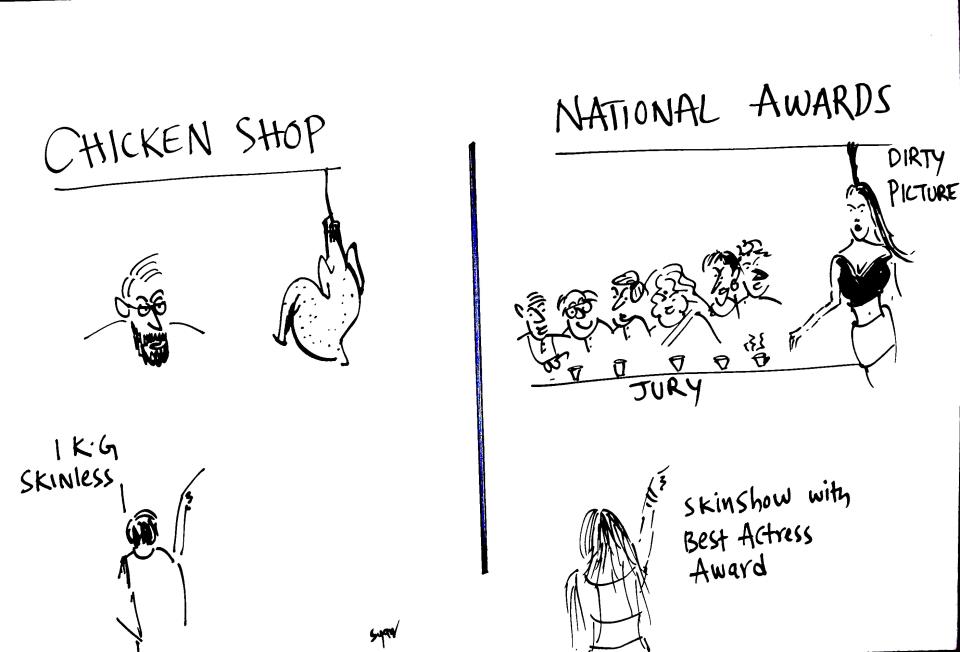
I start the book with reference to The Dirty Picture because it encapsulates how the sex siren in Indian cinema also doubles as a discourse about a moral and professional decline in the film industry, especially with the influx of women from lower caste and class backgrounds who pushed the boundaries of middle-class social mores. Here, I analyze a cartoon by Unnamati Syama Sundar themed on The Dirty Picture, which was shared on Facebook and later formed part of Jenny Rowena’s article in Dalit Web on Smitha. Syama Sundar’s cartoons emerge from Ambedkarite politics and are critical of the left-savarna complicity in sidelining Dalit concerns.
Syama Sundar highlights the problematic formulation of (what we could think of as a postfeminist form of) women’s sexual liberation in The Dirty Picture, which dilutes the social context of Dalit experiences and flattens variations in women’s experiences and struggles. He exposes the flip side to the liberal humanist take on the film by pointing to the complicity of savarna interests in framing it as a narrative of individual liberation. Enacting eroticized dance sequences as a secondary artist further relegated Smitha’s embodied labor to the status of inessential component for artistic value. Even in the discussions around the making of The Dirty Picture, Silk Smitha was less of a subject than a fetish-object to be molded to the needs of the box-office economy. Likewise, the film offers no inkling of the experiential or lived accounts of lower-caste actors struggling in a system in which the caste-class nexus and contact networks create opportunities.
Colorism is prevalent in the film industry, and it has been something that came up in my discussions with junior artists. There has been a tradition of creating different tiers of junior artists, depending on their looks and skin color, and this has been a practice that operates in other regional film industries as well. This practice also operates with the presumption of a savarna coded woman’s features as the preferred “default” and that is used as a yard stick to define what deviates away from it. While creative freedom in deciding who would best suit the role has always been an argument raised in favor of making changes in the skin color of actors, I think an informed discussion among the artists is important as well. I would be curious to know if make-over culture and the modicum of freedom it allows, makes people overlook cooptation.
RBF: In the book, you share how you sought employment in the film-making industry you were researching. “The position of helper that I was offered had a very nebulous job description,” you divulge, going on to say that because you had to “work across many departments…,” it benefitted your research.
I read with awe and amusement about how you negotiated being a researcher and employee simultaneously, encountering – as you did – “contradictory descriptions of the ‘contacts’ for whom [you] should be on the lookout,” or meeting the demands of the job when “additional challenges [were thrown] at [you] to see if you were capable of handling a ‘man’s job’”!
How did this insider’s perspective change the course of your research, if at all, and, because of your employment, what was made apparent to you that you may not have learned otherwise? While still on the topic of methods and research, what made you interested in this subject in the first place?
DSM: The initial thinking around this project started in 2010, as an aftermath to a focus group I conducted with teenagers to understand how they consumed soft-porn films as sex education material. In India, incorporating sex education formally into school curricula has faced multiple obstacles, both from religious groups as well as teachers’ organizations. Teachers, especially, felt that they were pressured into teaching sex-related material using safe sex paradigms, while deterrence is usually preferred in the conservative moral ethos of India. That’s what piqued my curiosity initially. As I started digging further, I realized that even though soft-porn films were widely available in cinema-halls and as DVDs, the production details of these films were not readily available. Most filmmakers and technicians who were part of these films used fictitious names in the credits.
Moreover, journalistic reports spoke about these films as a den of vice, where free sex and exploitative practices were rampant, and that too warranted more investigation. I left for Chennai in 2011 to do a pilot study and to see if this was a feasible project to carry out, since getting a list of the “real names” seemed the hardest to get through. I had to wait for over two years to get my first real contact, and more time was spent in the field to track down people. After all, the filmmakers who were associated with these films weren’t always comfortable coming out and owning these films as their productions.
This project has also been about a process of patient waiting. I stayed in Kodambakkam and took up stints of work in the industry to be part of the production process. Unlike a purely archival project or qualitative study, where you can work with a specific archive or a dataset, here the anonymity of the production practices necessitated a different model of approaching research. In many cases, it also involved waiting for clues and the right timing when the respondents would feel comfortable reconnecting and giving me details. This project is ten plus years in the making, and the extra time was also necessitated by the mixed methods I ended up using, including backup plans in case I hit roadblocks.
But it is precisely this kind of waiting that led me to my first contact. Becoming a familiar face in and around my research “localities” led to connections which led to the position of a helper. I think I could have written a book on soft-porn without these connections and experiences, but it would not be Rated-A. I think the insider’s perspectives were crucial to get a behind-the-scenes look at the film/labor ecologies, and to understand things that I couldn’t from archival work, or from analyzing media discourses alone. In many cases, I got interviews with film producers and directors only because someone or the other could introduce me to them—even more so in case of actresses who had left the industry or had moved into a different phase of their career, Shakeela included.
Some of the ephemera I collected as part of my research—lobby cards, posters etc. were a direct result of this generosity. Sometimes even though I didn’t actually collect some of the material, the very fact that I got to see and photograph them for analysis in my book (a continuity album, for example) was more than I could have hoped for if I didn’t have this access.
RBF: In addition to Silk Smitha, another figure you zero in on, as you have just said, is the iconic Shakeela who continues to be prominent in South India (and beyond), both for her filmic past and her more contemporary involvement in politics and sex education.
Of Shakeela’s trajectory as being emblematic of the soft-porn industry, you write that “her formidable bodily presence exposed the sexual contradictions of Malayali society. Soft-porn’s language of sexual excess allowed figures such as Shakeela to speak to diverse constituencies of desire, yet it also fixed their off-screen lives into the image of the sex siren … [F]or many [other women actors], working in soft-porn blocked them from ever entering the mainstream film industry. Thus, even as the genre of soft-porn proved ephemeral, fizzling out in the early 2000s, its effects on the careers and lives of certain actresses were longer lasting.”
Against the precarity of such employment, even as Shakeela may emerge as a legendary presence, and a feminist one at that in how she champions sex-positivity despite having intermittently faced social disapprobation, is hers necessarily an exceptional success story?
DSM: The soft-porn film industry’s promotion of relatively unknown female starlets also contributed to anxieties about female stars. The film magazines that showcased these starlets were keen to foreground their willingness to act in films that required “modern” and “bold” (i.e., sexual) roles and they thus began to associate this group of ambitious aspiring actresses with the madakarani and her sexual autonomy. So even though some of them—Shakeela, for example—can be labelled soft porn stars, this is not the same kind of stardom we see in mainstream, big-budget cinemas. Instead of appearing on advertising billboards and in television ads, these actresses fed fantasies through B-circuit cinema halls and film magazine centerfolds.
On the one hand, Shakeela fits this industry-type perfectly. Shakeela’s heavy-set body allowed her to fit into the archetype of the amorous “aunty,” a recurring figure in both visual and written forms of pornography throughout the country and a stereotype that gave imaginative access to the middle-aged woman next door. She started acting in these films almost like any other soft-porn actress, but the way that the image of soft-porn was so indelibly fixed on her is singularly exceptional. There is much industry-lore—some of which I discuss in my book—about how the mere mention of Shakeela’s name or even a cameo presence could impact a film’s circulation and reach. Many of my respondents called these “Shakeela films.”
So, Shakeela is exceptional in how she literally becomes the mascot for the entire form. I think this also makes her career longevity exceptional, even beyond soft-porn. Most soft-porn actresses disappeared from the industry after a short stint, or even when they are remembered—as for example, Reshma—it is through narratives of failure, loss, tragedy, etc. Shakeela on the other hand has managed her own agency in this regard.
An example of this, which I discuss in my book, is how she also been roped in as a sex education expert in a Malayalam promotional sketch (2023) for the Netflix show Sex Education. In the sketch, “Shakeela’s Driving School” stands in as a metaphor for sex education itself, her tips about driving being innuendos about sexual intercourse as she tells a couple that she is going to talk to them about an important chapter that may have been skipped by their teachers in school. Shakeela’s words of wisdom range from pointers on intercourse and foreplay, to ethical dictums about consent and slut-shaming, the importance of self-pleasure and protection, and, quite ironically, the importance of finding out each other’s likes and dislikes instead of copying what is shown in porn.
RBF: Moving from the films to their audiences, Rated A apprehends how “Malayalam soft-porn offers alternative ways of imagining the global.” This is especially so when considering the transnational circuit of the financing, distribution, and consumption of these films between Kerala and its diaspora in the Arabian Gulf.
“This traffic in contraband media objects and desires enables Kerala’s expatriate population in the Gulf to reconstruct a sense of a home when they are far away from it. If we understand these consumption practices as constituting a media public, then soft-porn’s media public can be also said to constitute a ‘transnational public,’” you muse.
In this investigation of the movement of soft-porn in the era of globalization, particularly as it helps create a sense of transnational identity, even as the conventional assumption may be that such influences are unidirectional (by which I mean simply arising in the homeland and then landing upon the diaspora), I imagine this was not always so?
DSM: You’re right in pointing out a certain kind of assumption of unidirectionality in global flows. But assumptions and ground realities can be very different. One of my central concerns in Rated A was in fact, the global aspect of soft-porn films, right from the way they took inspiration from American exploitation cinema, to their export as mediated packages of desire in the Middle Eastern Gulf. I was aware of the Gulf aspect even before I formally started my research…I mean almost every family in Kerala has someone/knows someone who works in the Gulf. So, the idea that soft-porn films would circulate there in some form was not much of a surprise. But I was surprised by the extent to which they were woven into imaginations of intimacy while away from home. I think of this as a kind of diasporic formation that is similar to food—taste and smell for example, are corporeal sensations that trigger memory, affect, and longing. Desires can function much the same way, especially when they are packaged in a media form as powerful as soft-porn.
I think this is a form of affective diasporic transnationalism that functions in a very different way from the picture-postcard version of nationalism as imagined in the Westward-bound NRI imaginations (Dilwale Dulhaniya Le Jayenga and so on) especially because it primarily bypasses the national. It’s a connection or a bridge between a very particular region of the nation, and certain sections of the Indian diaspora in the Middle East. When Malayalam soft-porn enters the Middle East through underground pirate circuits, it often circulates amidst Bangladeshi low-budget films and Pakistani mujra as “South Asian” pornography. Some of my Pakistani informants also spoke of soft-porn films that were available in Karachi’s Rainbow Center in Saddar, one of the hubs of video piracy in Pakistan.
In my book, I discuss how camps that house blue-collar laborers, for example, used to screen these films, or how soft-porn films also shape interactions between diasporic men living away from their families and sex-workers. Or even, how these films used to be smuggled into the Middle East as VHS/CDs/DVDs using ingenious strategies. There’s an amount of risk associated with this too— in the censorial atmosphere of the Middle East, there was also a common practice of labelling porn films as mythological films or home videos so that it minimized risk even if caught by Mutawa (The Committee for the Promotion of Virtue and the Prevention of Vice), the special police unit that enforces religious observations and public morality in Saudi Arabia. One of my respondents, a former video library owner, who sold soft-porn along with his regular wares in Dubai, told me that soft-porn CDs sold in video parlors might look to an outsider like “any other Malayalam film,” except for the text in Malayalam promising “juicy elements.”
These are all subterranean aspects of diasporic transnationalism that bypass (or rather cannot be contained within) the legal, formal channels of transnational relationships and their corollaries which are usually about diasporic workers’ rights, remittances to the home, and so on. The Gulf has always been a major presence in Kerala, of course, as a kind of peek into transnational affluence—it’s the region of aspirations where foreign goods used to come back to Kerala. With the circulation of soft-porn we have a slightly different kind of transnational movement—not about aspirations but about desires, through which the “province” literally flows back to the global cosmopolis.
RBF: While Malayalam soft-porn no longer exists as a genre beyond the early-2000s, you point out that it “enjoys an afterlife … on the internet [including social media],” in its reimagining in other films, and even as artworks. “Memories of soft-porn return not just as … circulating fragments, … but also permeate imaginations of gender negotiations ... This recirculation is significant for understanding how gender, sexuality, and media impact media publics in South Asia,” you emphasize.
Why is soft-porn, especially in its afterlife, a medium that makes such interrogations possible? And, in keeping with this notion, how would you like your book to lend itself to such processes and the study of cinema (South Asian and otherwise) more generally?
DSM: First of all, I think it’s a powerful form. Yes, these may not have been the “best of” kind of films in the pantheon of cinema, but the images and imaginations they gave rise to had a deep impact on the collective psyche of the nation, whether it’s the vehement opposition to these films, the risk-laden lives of the actresses, or the kind of gender discussions they led to overall. Though many of the films and actresses who appeared in these films are indeed forgotten, there is still an idea of “soft-porn films” that circulates and is remembered. Most people in the Indian media context may be hard pressed to shore up the title of a single soft-porn film (at least outside of Kerala), but they may still have a set of associations they make with the term “soft-porn” even though it may be regressive ones like for example, the stereotypical association with “South India.” These imaginations I think flow across time as repertoires of sexual performances and representations that become “lived” in current-day media whether it’s camming, adult streaming platforms, or influencer culture.
I discuss these kinds of resurfacings in the last chapter of Rated A. For instance, I look at one social media influencer to discuss how content creators use soft-porn’s tropes mediated through technological interfaces. Then there are new forms of erotic short-video series in platforms like Nueflicks or co-optation of soft-porn repertoires by streaming platforms like Alt-Balaji through shows like Gandii Baat.
And those are not the only kinds of memories and remembrances. As I discuss in the last chapter where filmmakers and artists have also started looking at the form as something that needs to be acknowledged and come to terms with. You can’t just hide away a piece of cinematic history forever calling them “dirty pictures.”
From Scroll.


%20by%20Bardroy%20Barretto.png)
%20by%20Bardroy%20Barretto.jpg)
%20by%20Bardroy%20Barretto.tif)
%20holds%20court%20in%20Nachom-ia%20Kumpasar%20(2014).jpg)
%20sings%20in%20Nachom-ia%20Kumpasar%20(2014)%20by%20Bardroy%20B.tif)